
Bearings
Older than English. Older than compasses. Still load-bearing.

Bearings is a systems word — six thousand years old, with four old meanings still active and none of them inspirational. The mechanical bearing carries friction so the rest of the system can keep moving. The endurance bearing carries difficulty without collapsing under it. The human bearing is what leaks out of the inside, whether you intend it to or not. The nautical bearing gives you a line into the unknown. This piece is an excavation of the word — what it has been carrying for six thousand years, and what surfaces when you take it apart.
Bearings is an old word.
It has been doing serious work in English — and in the languages English came from — for nearly six thousand years. It is not a metaphor. It is a systems word. It describes how something carries weight while remaining oriented. Strip out any of the three pieces — load, motion, orientation — and the word collapses. That is why it shows up in bodies. In ships. In machines.
Four Old Meanings, All Still Active
Underneath the word are four old meanings, all still active, none of them inspirational.
The first is the mechanical bearing. Inside a machine, a bearing is the component that absorbs friction so that everything else can move without being ground down. It does not eliminate friction. It carries it. The bearing wears so the rest of the system does not. When the bearing fails, the failure is rarely loud at first. The system simply starts to drag. Performance degrades while everything still looks operational from the outside.
The second is the endurance bearing. The oldest human meaning of the word, predating compasses by centuries. The 1913 Webster dictionary preserved it: patient endurance; suffering without complaint. Long before bearing meant a direction, it meant the dignified capacity to carry difficulty without collapsing under it. To bear what you are bearing. Not as performance. As fact.
The third is the human bearing. How a person carries themselves in the world — what is visible, what is legible, what other people read off the body and translate into status, discipline, control. Shakespeare could identify a man by his bearing. The 1917 Crabb’s English Synonymes draws a precise distinction: deportment is external compliance with rules; demeanor is the moral expression of a person; but bearing is the most interior of the three. It is what leaks out of you from the inside. The physical evidence of what you are actually carrying.
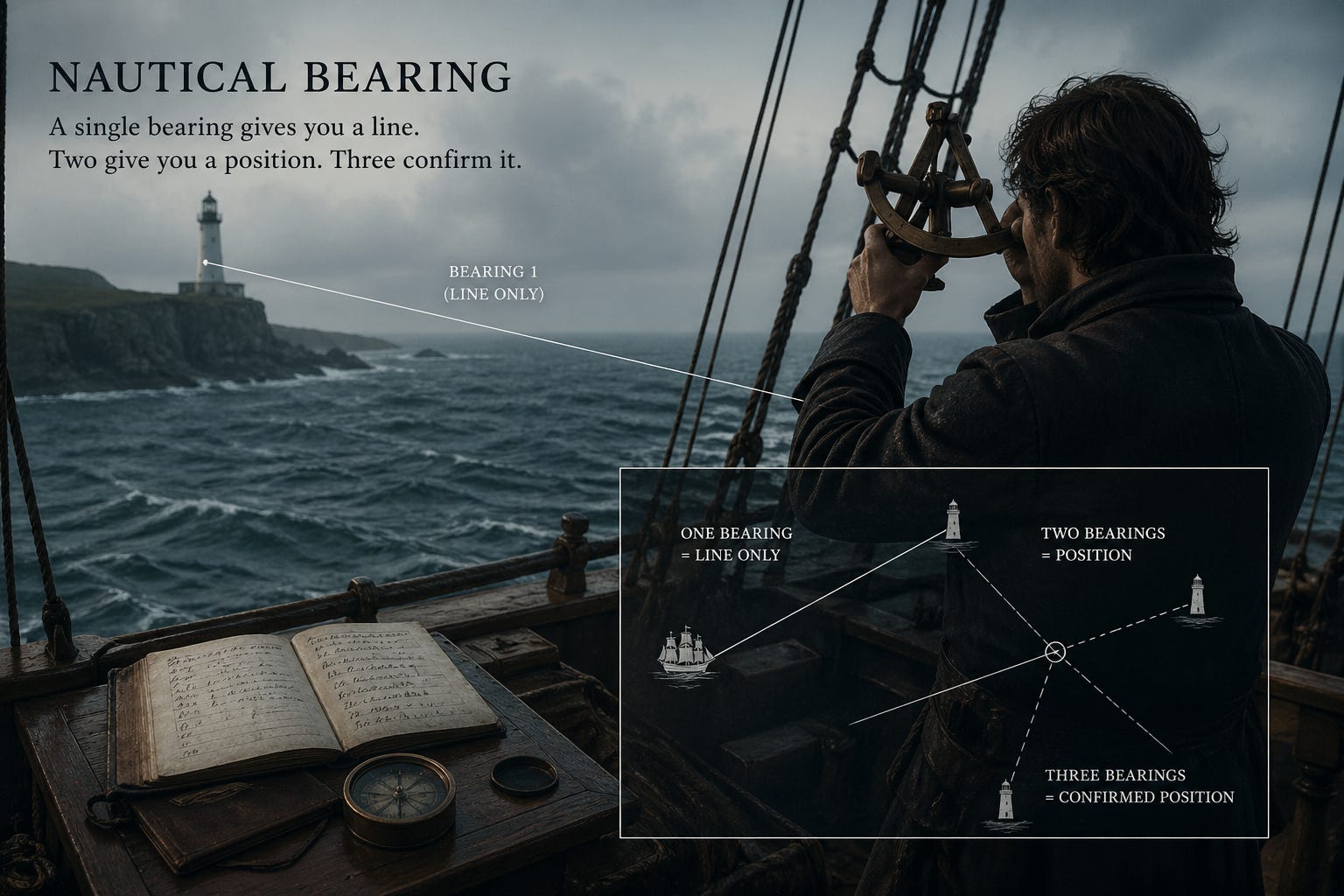
The fourth is the nautical bearing. The first attested use of the word in this sense is from the 1630s, in the era of long-voyage navigation. A bearing, technically, is the angular direction of one object from another, measured against a fixed reference point. Here is the part that almost no one knows: a single bearing does not give you a position. It gives you a line into the unknown. You point at one lighthouse, you draw the line, and you know you are somewhere on that line — but where, you cannot say. To know where you actually are, you have to take more than one bearing. Two intersecting lines give you a position. Three confirm it.
Plural for a Reason
This last meaning is the one that turned the rest of the word inside out for me.
To find your bearings is not to find your direction. It is to gather enough reference points that your position becomes locatable. The phrase is plural for a reason that the casual usage has lost. A single bearing tells you nothing useful. Multiple bearings, intersecting, give you a place to stand.
Thirty Years
I did not arrive at this through a vision exercise.
For more than thirty years, my body has been doing something my charts could not name. What I now know to be IBS-D was first diagnosed as hypoglycemia and treated with glucose. Then it was reframed as anxiety. Neither was true. Underneath both diagnoses was a single underlying condition: my body does not store iron. Once my ferritin levels drop below 80, I become highly symptomatic — and I never present with full anemia, which means I do not look like the patient anyone is trained to identify. For a quarter century I was dismissed by endocrinologists, primary care physicians, and multiple specialists. Each one took a single bearing, drew a single line, and could not place me. Each one was technically pointing at something. None of them gave me a position.
It was not until 2025, through the VA Health system, that I found physicians and a hematologist willing to address ferritin depletion directly. I recently completed my third iron infusion series. The pattern persists: infusions raise the level, my body fails to store it, the level depletes again, the symptoms return. The question of why my system will not hold iron in storage is still open. Recent research on ferritinophagy and the role of hepcidin in iron regulation — particularly the work coming out of Dr. Nupur K. Das’s lab at the University of Michigan — points to where I believe the answer lies. Hepcidin may be the gate. The testing has not yet been run.
I tell this medical story because the structural shape of it matters more than the diagnosis.
The Body Was the Bearing
For thirty years, my body was the mechanical bearing of the system. It was absorbing friction the rest of the system could not see. It was carrying the wear. The compensated baseline that made high performance possible — Navy, Wisconsin Army National Guard, doctorate, teaching, learning design, building a category — was not a sign that nothing was wrong. It was the bearing doing its job, quietly, while the rest of the system kept running.
The endurance bearing is the part that lasted thirty years undiagnosed. Patient endurance, suffering without complaint — the dictionary’s definition is exact, and it is also a thing I do not particularly want praised. It is what the body did because the system gave it no other option. When you cannot get a real diagnosis, you carry. That is not virtue. That is bearing.
The human bearing is the part that complicated everything. From the outside, the bearing looked clean. The external markers were all there — service, credentials, performance, output. The bearing was legible. The load underneath the bearing was not. People kept reading the outside of me and concluding I was fine. The Fragmentation Tax — what I now call the cost of operating across systems that were never designed to hold all of you at once — was accumulating behind a presentation that gave no one any reason to look closer.
When the Object Moved
The nautical bearing is the one that took me longest to understand.
For decades I had been navigating by a single reference point at a time. One specialist’s diagnosis. One credential. One academic role. One institutional trajectory. One version of who I was supposed to be. Each of these was a real bearing — it pointed at something real — but each one, alone, only gave me a line. I was always somewhere on that line. I was never sure where.
In late July 2019 I moved to Ohio for an academic opportunity. State number eight. The opportunity carried genuine professional promise, and then the pandemic arrived, and the institution went into its own structural crisis, and I was stranded inside a single bearing — a single role inside a single system — with no second reference point to triangulate against. When that single bearing failed, the failure looked like a career failure. It was not. It was a navigational failure of a kind I now understand structurally. I had been taking my position from one fixed object, and the object moved.
What followed was not reinvention. I want to be specific about this, because the language of reinvention is one of the things in this lane that has never resonated with me. I did not need a new self. I needed architecture. I needed enough reference points — health data, instrumentation, my own history, the academic literature on what my body was actually doing, the conversations with practitioners who finally looked at the right thing — to triangulate where I actually was. The work was not motivational. It was navigational.
The Pause Was the Work
This is what 2025 was. The year, in my own language, that life lifed. A forced pause, a forced reevaluation, and a forced confrontation with the cost of having built for years on default — even while I had been designing tools to help other people stop doing exactly that. The pause was not a break from the work. The pause was the work. Recovery is not what you do until you can get back to building. It is the period during which you collect enough bearings to know where you actually are before you build again.
The instrumentation matters. WHOOP biometric tracking, the labs, the data accumulation over years — none of it gave me an answer. It gave me visibility. It made the patterns observable: physiological signals, inconsistencies, system responses over time. This is the part that tends to get missed. You are not collecting data to find the answer. You are collecting data to make your position locatable. Data is the second bearing, and the third, and the fourth. You do not get a position from one number. You get a position from enough numbers, taken from enough angles, that the lines start to cross.

What You Actually Need
If you are in the middle of a pivot, or recovering from burnout, or somewhere on the long edge of a career that is not what you thought it would be, this is the part that I want to leave with you.
You do not need clarity. You need triangulation.
The standard advice in this lane treats lostness as a single problem with a single solution. Find your purpose. Find your why. Get clear before you move. The framing assumes that one true reference point, correctly identified, will tell you where you are. It will not. A single reference point, no matter how well-named, gives you a line, not a position. This is true in a ship, in a body, and in a life. You can be pointed at the most beautiful lighthouse in the world and still be anywhere on the line that runs from the lighthouse to your hull.
You become locatable when more than one reference point is in play. Your health is one. Your work history is another. The shape of your nervous system is a third. The institutional contexts you have moved through, what they cost you, what they returned, what they obscured — all of these are bearings. The voices that have always recognized you, even when your credentials did not — those are bearings too. Your body, which has been carrying something specific for as long as you have been alive, is a bearing the medical system will not always let you use. You may have to fight to use it. I had to.
You Are Not the Variable
I want to be careful here, because I do not believe people in pivot are broken, and I do not believe burnout is a personal failing. The point of view I have arrived at, after years of watching this pattern in myself and in everyone I have ever worked with, is structural: if you have to keep adjusting just to make things work, the system you are inside is broken. You are not the variable that needs to change. You are the bearing that has been carrying the friction the system would not absorb.
That sentence is also literally true of my body. My body has been carrying friction the medical system would not absorb. Until 2025 the medical system had no model for what my body was doing. It is my body, now, that is teaching the medical system what to look for. The patient is the instrument.
This is what I mean when I say bearings are plural. You do not navigate out of a hard chapter on the strength of any single insight. You navigate out by accumulation. By instrumentation. By the slow refusal to settle for a single line when what you need is a position.
The Snowmobile
There is a way of describing this that comes from my family. My grandfather, Robert Huibregtse, built one of the earliest snowmobiles in 1936. A gas can strapped to a big fan, sitting on a wooden sled with metal runners. He did not build it to solve a market gap or to invent a category. He built it because he had a question that would not leave him alone. Will this work? Can this carry me across what would otherwise stop me? My father carried the same instinct into engineering. Observe, test, adjust. No drama, no ego. The irresistible need to build the thing and find out.

I inherited the instinct and ran it through my own filter. Take it apart, understand how it works, rebuild it with intention. I have been doing this on my own life as long as I have been doing it on anything else. Bearings, in that frame, is not abstract. It is the work of figuring out how a system carries weight while remaining oriented — and the system in question, often enough, is yourself.
Finding your bearings is not a vibe. It is not a moment. It is not a single revelation. It is the slow, technical, unglamorous work of gathering enough reference points that you actually know where you stand. It is the body, the data, the instrumentation, the history, the diagnosis you had to fight for, the second opinion, the unfashionable evidence, and the willingness to say I am somewhere on this line, and that is not enough.
When enough lines cross, you have a position. From a position, you can move. Until you have a position, every direction looks plausible and none of them will hold.
This is the word I have come back to. It can carry what the others cannot.
Default → Design
— Dr. Sarah HUBREX