
Manufactured Ground
An excavation of the word "bridge."

Most people, when they say bridge, mean connection. That is not what the word originally meant. Bridge is one of the oldest working words in English — older than the Norman Conquest, older than stone arches, older than the figurative use of the word by nearly four thousand years.
At the bottom of every later meaning is a single repeated human act: take wood, cut it into beams, lay it across what would otherwise stop you. Make ground where there was no ground. Then walk across it. This piece walks the word backwards — through every later meaning, through the sacred crossings of the Roman and Norse worlds, all the way to the timber under your feet — to the original act bridge has always named.
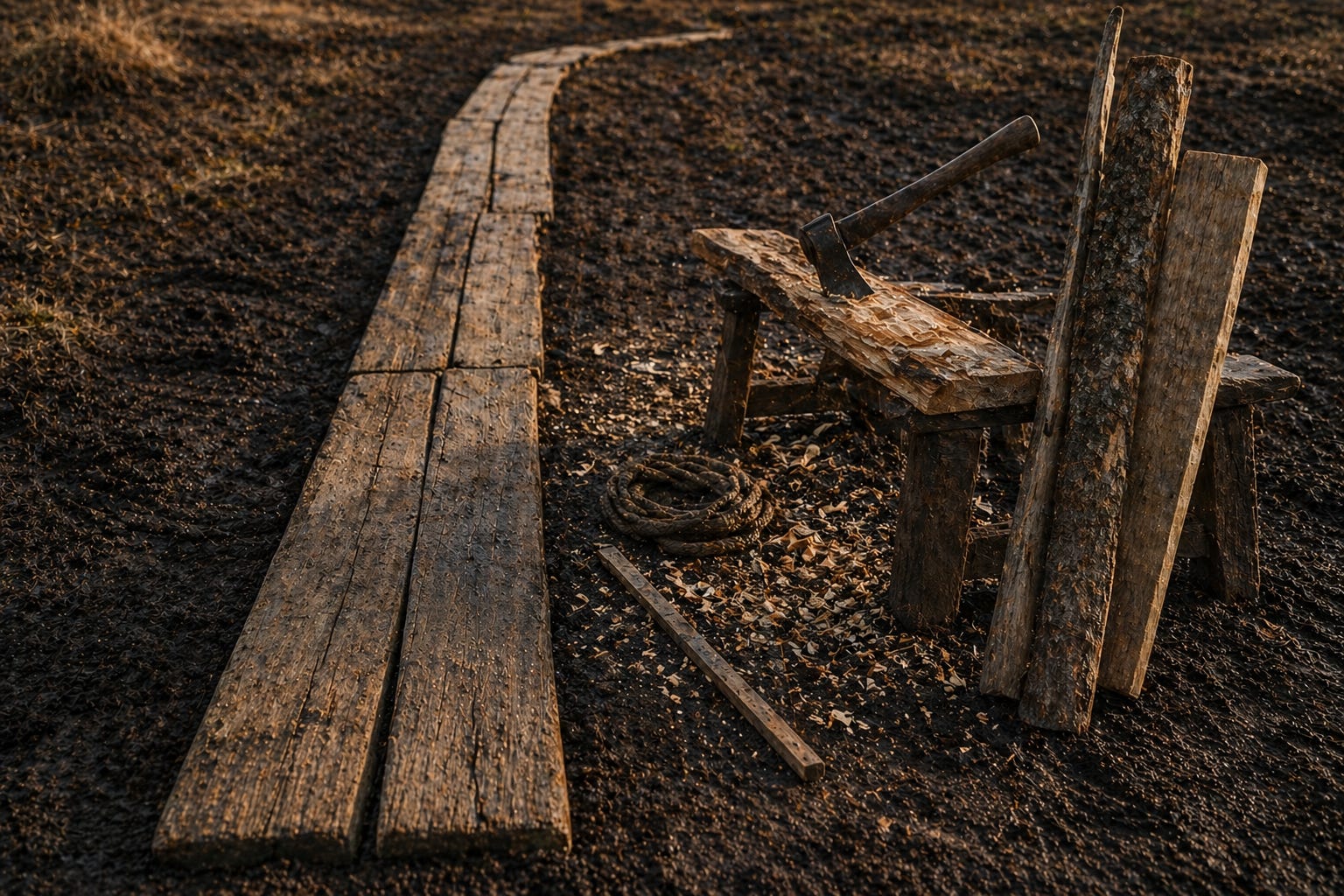
Wood. Laid flat. Across mud, or marsh, or river. That is what bridge originally meant.
Most modern users of the word would not recognize that. They would expect bridge to name a span — a structure that crosses a gap, an act of connection, a leap from one place to another. The figurative uses follow the same assumption: bridging differences, bridging the gap, bridging two worlds. All of these treat bridge as a word about connection.
It is not. Or rather: it has not always been. Bridge begins as a material word, not as a metaphor. It is a noun before it is an action. It refers to the planks themselves — the laid timber, a beam or log laid for passage — long before it refers to spanning, connecting, or crossing.
You stand on a bridge before you cross it. That order is not incidental. It is the structural truth the word has been carrying all along.

A Surface, Not a Span
In its earliest reconstructable layer — Proto-Indo-European, going back nearly four thousand years — the root of bridge refers to wooden flooring, planks arranged side by side, decking laid flat against unstable ground. Not a span. Not an arch. Not a leap across open water. Boards on wet earth.
Across every Germanic language that inherited the word, the meaning held: a constructed wooden crossing made of logs, planks, or brushwood, laid over marshes, streams, and ground that would otherwise refuse to be walked across. In Old English, brycg most often referred to a causeway — a raised wooden path through marsh — not to the dramatic span over a river that the modern eye assumes when it hears the word. Many early bridges were wider than they were long. They were more road than span.
What the word has always named, at its core, is the deliberate act of laying surface where there was no surface. That is the piece most people have lost. A bridge is not, in its oldest sense, a structure that crosses a gap. It is a structure that makes ground passable. The crossing is what becomes possible afterward.
When the Norman Conquest brought Latin pons and its descendants into English in 1066, English absorbed the family — pontoon, pontifical, pontiff — and kept brycg anyway. That is rare. English usually surrenders a native word to its French equivalent within a generation or two. Bridge held. The reason it held, I think, is that the Germanic word knew something the Latin word did not. Pons was about engineering — the arch, the stone, the achievement. Brycg was about timber. About what you laid down with your own hands when the ground refused to carry you. The act, not the architecture.
The Asymmetry
A bridge is directional but not reciprocal. You step onto it before you have crossed it. You stand on it while you are suspended between two places — no longer where you were, not yet where you are going. If it fails, you are worse off than before.
A door closes and reopens. A bridge does not. Burning a bridge is not the same as closing a door, and the language has known this for thousands of years. The cost of stepping onto a bridge is exactly the cost of having committed to one before knowing how it will hold. That cost is what bridges have always been about.
The Gap
For more than thirty years, my body was doing something the medical specialties had no bridge for. Endocrinology had a lens. Gastroenterology had another. Primary care had a set of templates. None of them connected to the next, and the actual condition — inflammation and malnourishment that eventually led to my body’s failure to store iron, even at lab levels that look normal because I do not present with full anemia — fit between specialties. It existed in the gap. And in the gap there was no path.
For a quarter century I was dismissed by specialist after specialist, not because any of them were incompetent, but because each one was limited by the structure they were inside. There was no bridge from what I was experiencing to what they were trained to identify. There was no bridge between the disciplines that would have let any one of them see the whole. The patient — me — was the only place where the gap was visible, and patients are not, in the system as it currently stands, expected to be the bridge.
So I became one. The data, the years of records, the academic literature, the cold-emails to the researchers doing the work that mattered — including reaching out directly to Dr. Nupur K. Das at the University of Michigan about the role of hepcidin in iron regulation, still waiting on a reply — these were not searches for an answer. They were planks. Each one a piece of laid timber across a gap the existing system would not span.
What Was Built For Someone Else
The same shape was true in the work.
For decades I was crossing bridges other people had laid. Institutional roles. Academic credentials. Hierarchical structures. I happened to fit the shape well enough to hide the friction underneath. From the outside, the crossings looked successful. From the inside, I was walking on someone else’s planking, and the friction underneath was the cost.
When one of those bridges finally failed under load — quietly, the way bridges actually fail, by simply ceasing to support the weight — what looked from the outside like a career failure was something more structurally precise. It was the failure of a bridge I had not built and could not repair. I could not, by any amount of effort, force a bridge that had been engineered for someone else to carry weight it had not been designed to hold.
What followed was not reinvention. I did not need a new self. I needed timber. The work that came next — the year, in my own language, that life lifed — was not a search for direction. It was the slow, technical, unglamorous practice of laying my own planks where there had been no surface to walk on.
What You Are Actually Doing
If you are in the middle of a pivot, or recovering from burnout, or somewhere on the long edge of a career that is not what you thought it would be, the most useful thing I can tell you is that you are probably not in a crossing. You are in a build.
The standard framing — find your way forward, find your next chapter, find your bridge to what’s next — assumes there is a bridge already in place, and that your job is to locate it and walk across it. There usually is not. The bridges that were built for the trajectory you were on were built for the trajectory you were on. When that trajectory ends, those bridges do not lead anywhere useful. The next thing requires building.
A bridge is what you stand on, not what you cross. You build it under your own feet, plank by plank, knowing that you have to commit to the structure before you have crossed it, and that if it fails you will be worse off than if you had stayed put. That is the real cost. Anyone who tells you otherwise has not built one.
The System Without a Bridge
I want to be careful here, because I do not believe people in pivot are broken, and I do not believe burnout is a personal failing. The view I have arrived at, after years of watching this pattern in myself and in everyone I have worked with, is that the systems most people are inside were not designed with bridges. They were designed for the trajectories they served. When you are no longer on that trajectory — for any reason, including reasons your body is choosing for you — there is no bridge to where you are actually going. The bridge has to be built.
If you have to keep adjusting just to make things work, it is not because you are the problem. It is because the system you are inside has no bridge for who you actually are. That is not a personal failing. It is a structural one. And it is exactly the kind of failure that can only be resolved by manufacturing the ground that was never laid.
What the Word Knew
The depth of bridge is visible in what every culture that ever built one has done with it.
The Romans built the Pons Sublicius across the Tiber in wood, by religious mandate, without a single piece of iron — and an annual ritual on the bridge cast straw effigies into the river, a sublimation of older human cost. Norse mythology gave us the Bifröst, the rainbow itself named as a bridge between the world of humans and the world of the gods. Hindu tradition has tirthas, holy crossing places where the earthly and divine intersect. The Roman high priest was named pontifex — bridge-maker — and when the Anglo-Saxons translated that title into Old English, they used the word brycgwyrcende. The same word the people who built the timber used for the ones who stood between mortals and gods.
This is what bridge has always known. It is not the connection. It is the manufactured surface — the thing built by hand across the refusal of the ground — that allows the connection to occur. Every later meaning is a version of that act. Anatomy, music, command, the figurative span between ideas: each is another instance of laying material so that something previously impossible becomes possible.
That is what bridge has always meant. Most modern uses of the word have forgotten it. The wood is still in there.
Default → Design
— Dr. Sarah HUBREX